

Is Nutricost creatine really the budget king? Here is the direct answer: Nutricost Creatine Monohydrate delivers 5g of micronized creatine monohydrate per serving — the standard maintenance dose — with 100 servings per 500g container, in a pure single-ingredient, unflavored powder. The honest take: the value proposition is outstanding, with an observed price around $22.95 working out to roughly $0.23 per serving — but it doesn’t dissolve fully in cold liquids, and there’s no sport-specific certification. This is a research-based review — I have not personally tested it.
A quick note on price: the ~$22.95 figure (about $0.23 per serving) is a price we observed, not a live guarantee — supplement prices shift constantly. The value argument below holds across the product’s typical price band, but check the current price before judging the math.
Product at a Glance
| Detail | Spec |
|---|---|
| Product Photo | 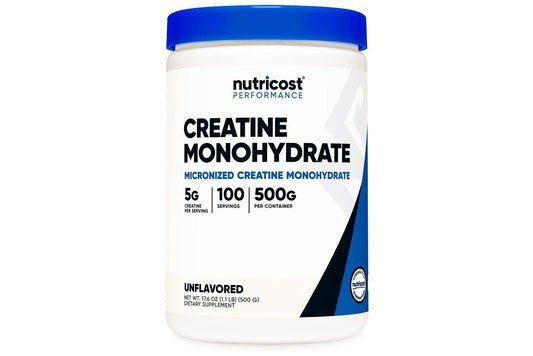 |
| Product Name | Nutricost Creatine Monohydrate Micronized Powder, Unflavored, 500g |
| Key Specs |
|
| Best For | Lifters who want the cheapest credible way to take 5g of creatine daily — no flavors, no extras, no premium |
| Where to Buy | Not sold on Amazon — details below. |
Product Overview
Nutricost’s creatine is aggressively simple: micronized creatine monohydrate, unflavored, nothing else. Each serving delivers exactly 5g — the maintenance dose used across creatine research — and the 500g container holds 100 of them. The powder is non-GMO and gluten-free, made in a GMP-compliant, FDA-registered facility, and third-party tested. There is no flavor system, no added ingredients, and no premium branding to pay for.
That simplicity is the strategy. Creatine monohydrate is a commodity ingredient — one of the most-researched sports supplements in existence — so the rational way to buy it is the cheapest credible version. Nutricost has built its reputation by being exactly that: a consistent bestseller frequently called the best bang-for-buck creatine available, with an enormous base of buyer reviews behind it.
What the Brand Claims (Read as Claims)
- Supports strength, muscle size, and recovery.
- Pure, single-ingredient creatine monohydrate with no fillers.
- Third-party tested; made in a GMP-compliant, FDA-registered facility.
These are brand and marketing claims, not independent findings. The context that matters: creatine monohydrate is among the most-researched sports supplements available, so the underlying ingredient has genuine scientific support — but the strength, size, and recovery claims describe intended benefits, and individual results vary with training, diet, and consistency.
What Buyers Like
- Outstanding value. Frequently called the best bang-for-buck creatine on the market — 100 servings of 5g creatine at an observed ~$0.23 per serving is genuinely hard to beat.
- Pure single ingredient, no fillers. One ingredient, fully disclosed, nothing hidden — exactly what label-conscious buyers want.
- Unflavored mixes into anything. Protein shakes, juice, water — the neutral profile disappears into whatever you are already drinking.
- Consistent bestseller. An enormous base of buyer reviews and long-term sales history make this a known quantity, not a gamble.
What Buyers Complain About
- Doesn’t fully dissolve in cold liquids. The micronized powder still needs stirring or shaking — it won’t vanish into ice water on its own.
- Mild bloating or digestive discomfort for some. A subset of users reports GI issues, especially during loading phases with higher daily doses.
- No sport-specific certification. There is third-party testing, but no NSF Certified for Sport or Informed-Sport certification — tested athletes may need a certified alternative.
- Generic branding. The no-frills packaging won’t impress anyone — though at this price, nobody is paying for the label.
Red Flags and Caveats
- Stay well-hydrated. Creatine draws water into muscles — drink plenty of water daily while supplementing.
- Kidney conditions, pregnancy, nursing: consult a doctor first. Talk to a healthcare professional before use if you have a kidney condition or are pregnant or nursing.
- Skip the loading phase. Loading (20g/day) increases the chance of digestive discomfort — and 5g/day works fine without loading, it just saturates muscles a few weeks slower.
Healthcare-professional note: consult a healthcare professional before use if you have a kidney condition or are pregnant or nursing. Creatine is well-researched, but individual medical situations deserve individual medical advice.
Frequently Asked Questions
How much creatine should I take per day?
5g per day — the standard maintenance dose used in creatine research, and exactly what one serving of this product delivers. There is no evidence-based reason for a typical lifter to take more for maintenance.
Do I need to load creatine?
No. A 5g daily dose saturates your muscles fully within a few weeks without any loading phase. Loading (around 20g/day for 5–7 days) gets you there faster but increases the chance of bloating and digestive discomfort — for most people, the patient approach is the comfortable one.
Does creatine cause bloating?
It can — mild bloating or digestive discomfort affects some users, especially during loading phases with high daily doses. Sticking to 5g/day without loading and staying well-hydrated minimizes the issue for most people.
Is unflavored creatine really tasteless?
Essentially, yes. Micronized unflavored creatine has a neutral profile that disappears into shakes, juice, or water. The caveat is texture, not taste — it does not fully dissolve in cold liquids, so give it a good stir or shake.
Verdict
Nutricost Creatine earns the “budget king” title honestly: 5g of micronized creatine monohydrate per serving, 100 servings per container, third-party tested, made in a GMP-compliant facility — at an observed ~$0.23 per serving. For lifters who want the cheapest credible daily creatine, this is the rational default.
The compromises are minor and predictable: stir it well, skip the loading phase, stay hydrated, and tested athletes should note the absence of sport-specific certification. None of that changes the math — this is the best value in creatine for almost everyone.
