



If you are thinking about buying Daily Language Review from Evan-Moor, here is the short version: it is a straightforward daily workbook series that gives students a few minutes of language-arts practice every school day. Nothing flashy, nothing complicated — just short, repeated exercises in grammar, punctuation, and sentence skills.
We spent time digging into the series — what is actually inside, what parents and teachers say about using it day to day, and where it falls short. The honest verdict: for teachers and homeschoolers who want a low-prep daily warm-up, it is one of the most practical options out there. But it is not a full curriculum, and it will not thrill every student. Here is the full picture.
Product at a Glance
| DETAIL | SPEC |
|---|---|
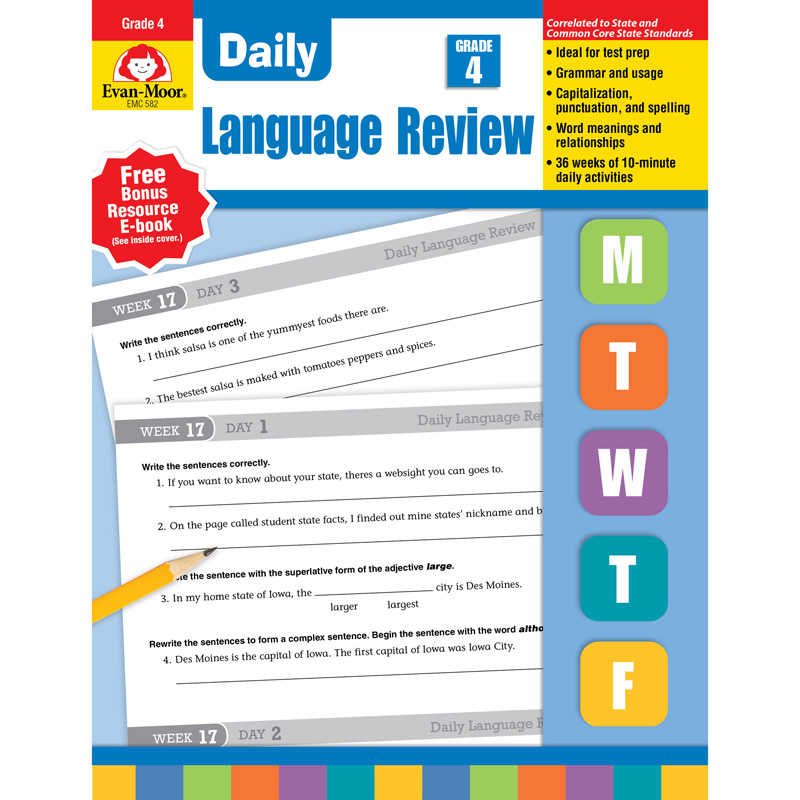 | Evan-Moor Daily Language Review — Teacher Edition (grade-level editions are separate workbooks) |
| Grades covered | Grades 1–8, with a separate edition for each grade |
| Pages | 112 reproducible pages per grade-level edition |
| Answer key | Included in the Teacher Edition |
| Format | 36 weeks of short daily activities (publisher claim); Common Core-aligned (publisher claim) |
| Best for | Teachers and homeschoolers wanting a quick daily language-arts spiral review |
| Not sold on Amazon — details below. | |
What Is Daily Language Review?
Evan-Moor has been publishing classroom materials for decades, and Daily Language Review is one of its longest-running series. The concept is simple: a consumable workbook that gives students a small set of language-arts tasks each day — fixing capitalization, choosing the right punctuation, identifying parts of speech, rewriting sentences, and similar bite-size jobs.
The series covers grades 1 through 8. Each grade level is its own separate workbook, so you buy the edition that matches the student — there is no single book that spans all grades. The Teacher Edition is the version most people buy, and it comes with an answer key, which matters more than it sounds when you are checking work for a whole class (or even one kid) every single morning.
Each edition runs 112 reproducible pages. The publisher describes the program as 36 weeks of daily activities, aligned with Common Core standards. Treat those two points as publisher claims rather than independently verified facts — but the structure is exactly what it sounds like: a school year of short daily practice.
How a Typical Day Works
The format is spiral review, which is a plain way of saying the same skills keep coming back around. A Monday-through-Thursday page might ask a student to correct a sentence, add commas, pick the right homophone, and combine two short sentences. Friday often brings a slightly longer set or a review of the week’s skills.
Each day’s work takes most students about 10 to 15 minutes. That brevity is the entire selling point: it fits into a morning routine, a warm-up slot at the start of class, or a homework folder without eating the day. Over weeks, the repetition is meant to move skills from “we covered this once” to “this is automatic.”
What We Like About It
- It takes only 10–15 minutes a day. Few programs respect a teacher’s schedule this well — the daily dose is short enough to actually happen every day.
- The spiral-review format builds skills gradually. Concepts resurface week after week, so students get repeated chances at things like punctuation rules instead of one shot in October.
- The Teacher Edition includes an answer key. Anyone who has tried to check a stack of grammar exercises without one knows why this matters.
- It works as a diagnostic tool. When the same type of error keeps showing up in the daily pages, you have found a skill gap — and you found it early.
- It is genuinely low-prep. Open the book, hand out the page, done. No printing marathons, no lesson planning.
The Honest Complaints
No product is perfect, and this one has real drawbacks depending on the student.
- The repetition can bore advanced students. The same daily format, five days a week, 36 weeks a year, feels like a grind to quick learners who mastered the skill in week two.
- Some users want formal weekly assessments alongside the daily practice. The series is daily practice only — if you want quizzes or unit tests, you will need to create or buy those separately.
Who Should Buy It — and Who Should Skip It
The best fit is clear: teachers and homeschoolers who want a quick, daily language-arts spiral review with minimal preparation. If your main curriculum moves fast or skips grammar drills, this fills the gap nicely.
Who should skip it? If your student is already advanced and gets restless with repetitive work, the daily format may cause more eye-rolling than learning. And if you are looking for a complete language-arts program, this is not it — Daily Language Review is practice and reinforcement, not instruction. It does not teach new concepts from scratch; it keeps old ones fresh.
The Bottom Line
Daily Language Review does exactly what it promises: short, daily language-arts practice with an answer key, in a format that takes minutes a day. It is not exciting, and it is not a curriculum replacement. But for its actual job — keeping grammar, punctuation, and sentence skills warm all year — it is hard to beat for the price of a workbook. If you want a no-fuss daily warm-up, this is a solid pick. If you want depth, assessments, or excitement, look elsewhere.
Frequently Asked Questions
What grades does Daily Language Review cover?
The series covers grades 1 through 8, with a separate workbook for each grade level. You buy the edition that matches the student — the content is grade-specific, not one-size-fits-all.
How long does each day’s lesson take?
About 10 to 15 minutes per day, according to the publisher and most users. That short daily dose is the whole point of the series: a quick warm-up rather than a full lesson.
Is there an answer key?
Yes. The Teacher Edition includes an answer key, which is one of the most-praised features among teachers and homeschoolers — checking daily work goes fast.
Is Daily Language Review enough on its own?
Not really. It is designed as daily spiral review — practice and reinforcement — rather than a complete language-arts curriculum. Most users pair it with a main ELA program that handles instruction.
